

A Story About Disabled Dignity
Or: A Case of "I Do Not Think That Means What You Think It Means"

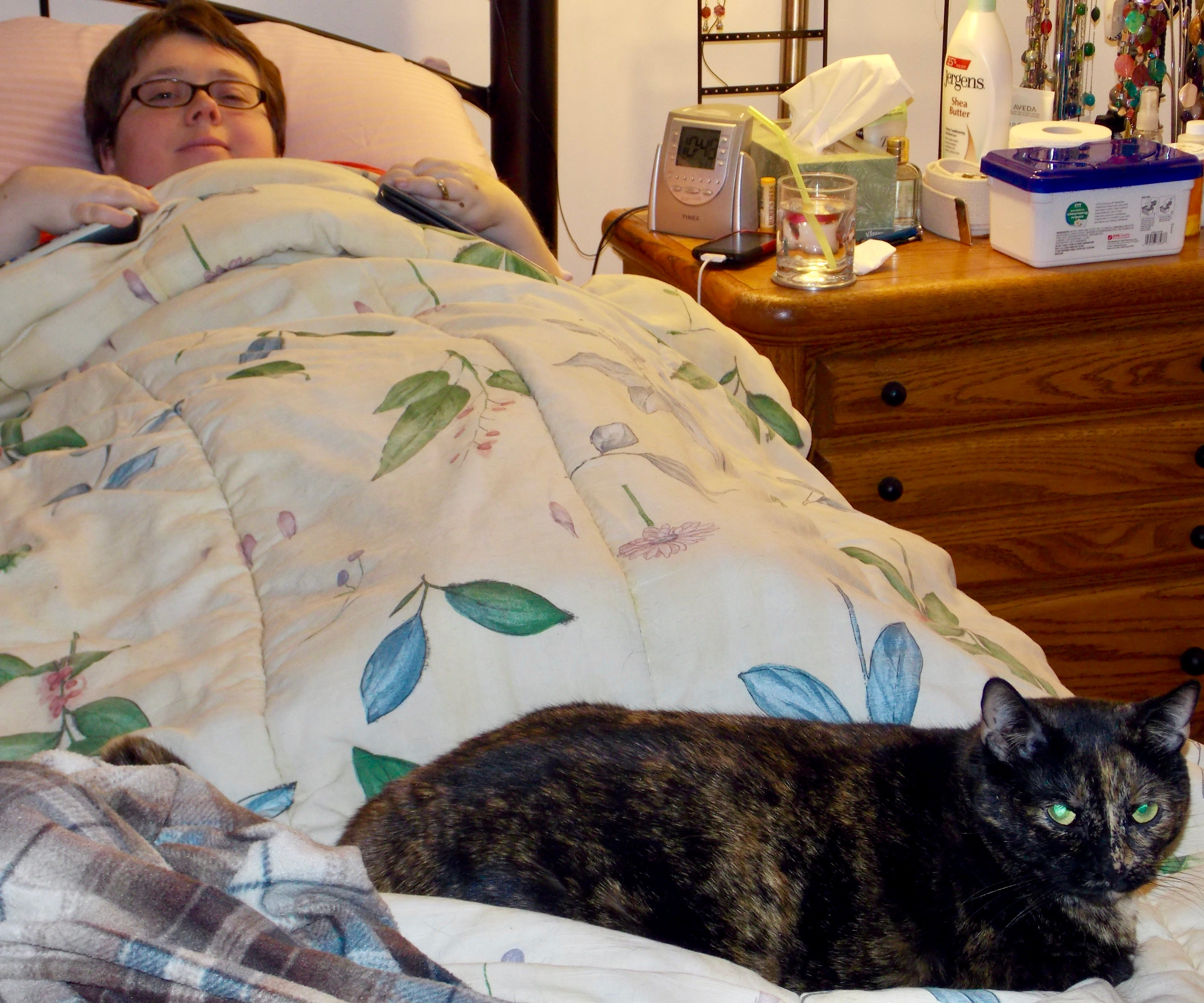
Image Description: Kelly lays undignified in her bed at home the day before her knee revision surgery. She has short brown hair, oval-shaped glasses, and a small smile. Her arthritic arms lay over a yellow floral comforter gripping an e-reader under one arm and a TV remote under the other. At the bedside is a table filled with medical items including a rolled up transfer belt, skin lotion, tissues, a glass of water with bendy straw, wet wipes, and medications. On top of the comforter at her feet is an extremely dignified calico cat guarding her protectively. (Note: Our kitty is still a fierce warrior at age 17!)
After my knee revision surgery to install a new artificial knee joint following an infection in the original joint replacement, I spent six weeks in a rehabilitation unit connected to the hospital where I had my surgery to launch the start of my long recovery. It may sound surprising, but staying in a rehab was something I carefully planned in advance, despite my reluctance to live away from home (including my dear husband and cat) for so long.
Planning for Rehab
I discussed the idea of in-patient rehab with my doctors while planning out the two surgeries required to first remove the infected knee and then to insert a new prosthesis (with home care and IV antibiotics in between). When I had my first four joint replacements over the course of a year and a half as a teenager (two hips and two knees), I stayed in the hospital for long periods of time and then a rehab facility closer to home at the end of the journey with the goal of strengthening my recovery through intensive daily physical therapy. At that time, there was also just the plain fact that my family’s home was inaccessible and I needed some amount of strength to handle the environment when I returned.
With this past experience explained, the surgeon caring for me during the infection treatment and knee revision agreed that a stint in rehab would likely be helpful for my recovery. I needed to regain some strength before returning home to our apartment. Although it was mostly wheelchair accessible, the bathroom door was narrow and its space small, which required some ability to stand and hop. Additionally, practically-speaking, having physical therapy “in-house” would make recovery a lot easier, as I wouldn’t have to travel 30+ minutes each day to get to appointments and then back.
The Confinement of Life in a Facility
As much as I geared up for the challenges of the surgery, I also had to brace myself for being confined for weeks to the rules, regulations, and habits of the rehab ward. It was going to be difficult to put my own life and preferences on pause, but I was willing to do it for the long-term goal of healing and recovery.
If you have never stayed in a physical rehabilitation facility (also known as a short-term nursing facility) then a similar feeling can be recalled with an overnight hospital stay. In much the same way, you surrender your body over to the control of others. They tell you when to eat, restroom, wash, and do anything that involves any amount of physical assistance.
Since my left leg was literally immobilized in a large brace to protect the fresh, new knee, I couldn’t get up by myself. I needed assistance transferring to my manual wheelchair or standing to hop slowly using my rolling walker (that I brought myself, unearthed from my closet since the first round of joint replacements). I couldn’t bear any weight on that leg at first, so every bit of movement was careful and effortful.
Of course, in addition to my surgical recovery, I came in with my pre-existing disability. My severely damaged joints limit my strength, reach, and independence in all the ways you can imagine. When someone brought a meal tray, I needed them to put it in just the right place and open containers — otherwise I literally wouldn’t be able to eat.
The Suspension of Human Dignity
The inherent premise of the experience of staying in a hospital or rehab is that it is undignified. It should be highlighted within the admission papers: “You will come in to heal, but in exchange all dignity is temporarily excised. Be prepared to live by the illogic of our rules and the humility of physical dependence.” There is no choice but to live by the mysterious culture of the institution and the habits of its workers.
Just to name a few indignities, the rules mandated that I hand over and have the facility control my medications, which they did poorly (trying to administer them to me on the wrong days and times despite my protests) and even threw some of them away in front of my eyes then later denied it (not inexpensive medications that I had purchased, brought in, and submitted for their supposed management — by the way, lessen learned not to do that). One staffer admonished me for peeing too much and having an inconvenient schedule for when I needed to go to the restroom. Another night my roommate lay in her waste for hours when both our repeated calls for assistance went unanswered. All of this occurred at what is known to be a “nicer rehab facility.”
Extra Help with Coping
It was hard going — honestly, harder than I had imagined, even though my spouse commuted every day to visit and help take care of me. My husband did a lot of tasks that should have been on the nursing staff and (frankly) he should have been paid! He assisted me in washing, dressing, getting to the restroom; went to physical therapy sessions with me; and helped me do additional exercises throughout the day. Most of all, he kept me motivated and working to get back home to our shared life.
As much as I would fight the restrictions and neglect of the rehab facility, I also became numb to some of the indignities like staffers walking in and out of the room without warning, living in thin and revealing gowns, and needing help with all the physical needs of my body. My sense of autonomy faded, but my frustration also grew. I kept visualizing my freedom and working towards the goal of returning home.
As my therapy and healing progressed, so did the exercise sessions and the practice moving about with my rolling walker. The revealing hospital gown wasn’t a modest garment for exercising hard and perambulating the hallways aloft my device, so I asked my husband to bring me some clothes that would suit the purpose. We decided on t-shirts and boxers, so that I was covered and because they were loose enough to fit over the bulky leg brace that I couldn’t remove for several more weeks. At least then my bum wouldn’t risk being exposed as I worked and these clothes weren’t too difficult to put on with the limits of my leg brace.
The Final Indignity
For several weeks this jerry-rigged outfit suited the situation. I went to physical therapy and I improved in my practice walking. The goals I needed to reach for release from the rehab slowly came into view. Then one day, while at home, my husband received a call from the rehab unit’s nurse manager explaining that my clothes are inappropriate and undignified. She explained that “they are only looking out for my dignity” and that “they want me to be ready for returning to a professional setting” like work.
Flummoxed, my husband explained that they were clothes for physical therapy that I had personally selected and not for the office because that was what I was doing: recovering from a knee replacement. He asked if they knew I was on medical leave from my work at the time, where I was a vice president at a public relations firm, and that I knew how to dress for the office, but that it was inappropriate for my physical rehab and the leg brace that they were well aware that I still required.
Additionally, he asked the nurse manager why she was calling him and not speaking with me — you know, the actual patient and disabled person in question. Her refusal to walk down the hall and speak with me was perhaps the greatest assault on my dignity (as opposed to my physical rehab clothes) because she was assuming and acting as if I was incapable of having the conversation. What was more infantilizing than refusing to engage with me in a discussion about supposedly protecting my own dignity?
As you can guess, my husband’s articulate and logical arguments with the nurse manager on the phone got us nowhere. And of course, when I learned about it I became incensed. My efforts to advocate for my own dignity failed.
In the end, I was forced to endure having gowns tied on me, over my clothes, to soothe their attire concerns. Let’s just say I didn’t feel any more dignified, just hot and bothered. Thankfully, I only stayed a few days longer before making as swift an exit as possible from the rehab that was more concerned with insulting my dignity than actually supporting it.
Ever since, whenever someone (usually nondisabled) talks about protecting my dignity or that of disabled people in general, I tense up. Because what follows is usually an assault on disabled dignity that must (yet again) be somehow endured or circumvented.
Thanks for reading Rolling With It! I love hearing from readers, so comments are warmly welcomed. If you enjoy this newsletter, please “like” it to let people know it is worth checking out. Thanks so much for your support!
As an RN for 40 years, I know there was no excuse for the nurses' attitudes and judgement. No one should have to lie in their own waste. The potential for bed sores is already heightened in a facility, that lack of care just is inexcusable! As to your wardrobe choice. . . you were more covered up than wearing the gown.
Rant over. I'm so sorry you were treated that way. Thank you for bringing this forward.
Oh, Kelly. My heart breaks for you and for EVERY person I have ever loved and worked with in a SNF. I want to so much for everything you described to be an aberration and I know that's just business as usual for our often uncompassionate, undertrained and over-taxed healthcare system. *sigh* Big hugs and endlessly well-supported trips to bathroom, my friend.