

How to Know When to Break Decorum?
Or: Was It Already Broken?


Image Description: A piece of shattered glass with a grey background.
Admittedly, my natural resting attitude towards others is nice, polite, and aiming to be gracious. I tend to give others the benefit of the doubt because we are all trying, often struggling, only rarely succeeding.
Unfortunately, this stance of mine has not infrequently been met with abuse (taking advantage of my kindness) or underestimating my determination — especially when it comes to advocating for myself or on disability causes. Just because I may be polite, doesn’t mean I am not serious — as well as seriously persistent.
When I take on an advocacy fight, I do not undertake it lightly. I think long and hard on a few simple questions. Do I care enough to keep fighting in the face of resistance, silence, and stonewalling? Do I have enough energy and persistence to keep at it? Am I willing to keep going, even if I don’t win in the short-term or (even) long-term (but will persist until I do)? If I don’t say ‘yes’ to all these questions, I lift my hands in (temporary) surrender and chalk it up as a fight someone else needs to take on, isn’t my current focus or where my strengths lay, or just isn’t worthwhile enough for my scarce time and energy.
On the other hand, if it is one of the rare fights that I accept and add onto my teetering tower of responsibilities: it is game on! I may start politely, but I understand that persistence may require more — the breakage of decorum.
Launch the Armada Nicely and Politely
There is something in my nature that demands beginning with the polite niceties. I will write a letter, make a call, or set a meeting — but always with a specific complaint and suggested remedies in mind. I always hope that these beginning overtures will result in a change or recognition of the offending party that they can do better. However, rarely are these hopes met.
If they are, it is usually a fairly straightforward issue. For example, I recently sent a hotel a list of all the issues experienced in their accessible room: missing a pull down bench in their roll-in shower room (requiring requesting a plastic chair for use), lack of a wheelchair-height mirror, non-operating thermostat, and door threshold that required a running start to surmount in my wheelchair. They responded quickly with a thanks for letting them know and that the property will be working to fix these issues. Nice and well-received. (However, I won’t really know the actual impact since I am not returning to that city anytime soon.)
Conversely, the usual reaction is that I am ignored or placated with a nonresponse or form letter. This will not suffice.
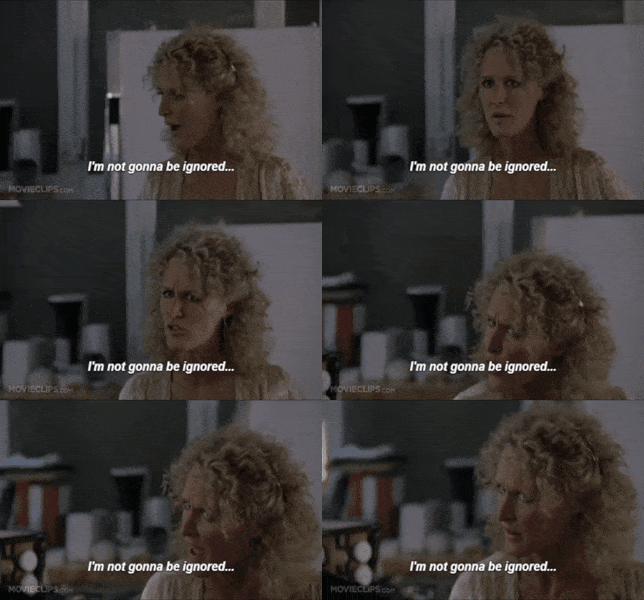
Image Description: A scene from the movie “Fatal Attraction” when Glen Close approaches in a threatening manner and says “I’m not gonna be ignored…”
Baring the Teeth, But Just a Little
While I don’t throw politeness out the window at this stage, the silk gloves come off and the metal gauntlets come on. I must insist, press for concrete action on a specific timeline, and request prompt follow up. I assert the law (wherever I can) and common decency (most definitely). I use citations, links, photos, and any kind of evidence that I know (from many years of experience) I need to collect because of being disbelieved and ignored so many times. I begin a list of interactions organized by date and start saving these items into a file. As the fight progresses, I meticulously add notes and details.
This may be just the first battle over many in years to come. While a conclusion can happen at any time, once I start and have not witnessed the repair of the situation I cannot withdraw. Periodically, I may ask myself: can you continue? And most of the time I feel that I have to because it is not about me. It is about all the other disabled people encountering the same situation and all those that come after for decades to come. So, if it was important enough to start the journey, it must be traveled and resolved under my watch.
When Was Decorum Breached, Exactly?
It’s not something I do easily, breaking decorum. And I think it is actually false in saying that I was the one who broke it first. However, it is my insistence on remediation, repair, and renovation that is typically taken as the insult.
Strange, how the guilty party is appalled that I demand accessibility, equality, and inclusion. How dare I want what everyone else enjoys? Who do I think I am — a human with rights? What nerve!
Conversely, I say that:
Maintaining an inaccessible business (say, by refusing to install a ramp or make the accessible entrance available when asked) breaks decorum.
Repeatedly breaking my various wheelchairs over the years when I fly your airline breaks decorum.
Refusing to provide me equal service (especially when I have requested it weeks in advance) breaks decorum.
Declining to speak with me at all about remedying accessibility barriers and developing an acceptable plan and timeline together breaks decorum.
But because I am the marginalized party in these conflicts and the one who doesn’t hold the power — the fact that I point these issues out, make requests to fix them, and persist in following up until my body literally wears out — means that I am the individual perceived as violating decorum. If only I could attribute some foul or exciting behavior to my polite requests for equality and inclusion! That would be so much more exciting for you to read!
Flames on the Side of My Face
Thus far in my years of advocacy, I haven’t had the opportunity to break decorum in bold or news-making ways (see next week for some stellar examples). I only have had the warm sear of hot anger burning in my body, the moments of unleashing lashing assaults in words, and the promise to continue demanding that the promises of accessibility and equality be met.

Image Description: A scene from the movie “Clue” when Madeline Kahn describes her anger as “flames on the side of my face.”
My anger comes from having to keep persisting on these fights when the offenders know they are in the wrong. It comes from being forced to spend time and energy on things that should just be made right when they are identified as problems. It comes from being ignored, denied, and gaslit for far too long. To be blunt, propriety and decorum have let me down if it is used as a bulwark to stop doing what is right and just.
In that sense, perhaps the time for me to really make an effort to truly defy decorum is approaching just about now.
Thanks for reading Rolling With It! I love hearing from readers, so comments are warmly welcomed. If you enjoy this newsletter, please “like” it to let people know it is worth checking out. Thanks so much for your support!
Great points. I would also say that someone casually asking me “what’s wrong with you and why are you using that [mobility aid]” is a breach of decorum. I’ve got better at not feeling I have to give them the details. Just the other day I managed to reply with a “oh I’m not going to get into that” - with great decorum!
As someone who suffers from an excess of decorum, thinking about inaccessibility itself as a breach of decorum is super helpful in trying to be a little more bold in my advocacy!