

News Comment: Searching for Respect with Lucy Webster
Or: Fighting Persistent Dehumanization


Image Description: A message is spray-painted on a messy yellow wall in green and black paint that reads: “Respect Existence or Expect Resistance”.
One of my favorite writers on Substack is Lucy Webster and her newsletter called The View from Down Here. She writes about her experiences as a disabled woman and has published a book of the same name about “being disabled in an ableist world.”
Lucy always has something interesting to say in her newsletters and contributes a vital voice exploring the disability perspective. Her recent piece titled “Would you please treat me like a person?” hit me hard in the gut because it is all about dignity and respect for disabled people.
The Injuries Sustained While Being Dehumanized
The first line of this essay was both epic and magnetic:
“Do you know what it’s like to be dehumanised in your own living room?”
She explains that she was trying out new personal caregivers and how this particular person auditioning for the position flunked out on the first day with what I think is a pretty basic “they should know better” scenario. Lucy explains:
“But the big issue for me was that she pushed my chair, with me in it, without asking.
In case this doesn’t strike you as too egregious, imagine a stranger coming up behind you as you walk around your own house, silently picking you up and depositing you a few metres away.
Actually, you probably can’t imagine it. Because no one would ever do that to a person who wasn’t a wheelchair user. It would be seen as… bizarre, rude, a gross invasion of both personal space and bodily autonomy.
Well, as should be blindingly obvious, it is all of those things when it’s done to wheelchair users, too.”
This is a situation that I have also experienced many times (thankfully not in my own living room) and always become enraged about. It seems so fundamental that you do not ever touch another person without permission or invitation, much less endeavor to move them around like furniture.
The Roots of Dehumanization Are Buried Deep
Lucy boils it down to the essence behind what happened:
“The fact that it remains not blindingly obvious to a fair few people - including ones who want to work with disabled people (dear god) - is because these people, often subconsciously, don’t think disabled people deserve said personal space or bodily autonomy. To them, the normal rules of how to treat people do not apply to those of us whose bodies and minds are seen as different.
And the assumption buried under that is even more fundamental:
We’re not really people.”
Lucy has come to recognize the feeling of being dehumanized in her body, and on reading this essay I realized I can do the same thing. Often, I try to tell myself otherwise and convince myself that I am misreading the signals. But after this newsletter, I am trusting my gut instincts forevermore about when and where I feel the stomach-churning sensations of dehumanization.
Dehumanization of Disabled People Grows from the Bog of Societal Ableism
Lucy is right that this is all too prevalent in the professional caring and medical spaces. I experience it all the time when seeking health care. But she re-iterates an important point:
“But the problematic behaviour and attitudes of (some) people in the care industry do not arise out of nothing. They are distillations of the way society as a whole has dehumanised disabled people at every turn.”
These moments of people denying the humanity of a disabled individual emanate from the wholesale dehumanization and devaluing of people with disabilities. It comes from a culture marinating in ableism and refusing to question the fundamental basis of these judgments and stereotypes.
Can Disabled People Get Any Respect?
While Lucy maintains her dignity that is inherent in her humanity, she shared a painful example of being denied the respect she deserves (even more so as an employer of the potential personal caregiver).
Not to make light, but it makes me think of Rodney Dangerfield and his unending and elusive request for respect. If an older white man can’t find the respect he is seeking, what hope is there for disabled people?
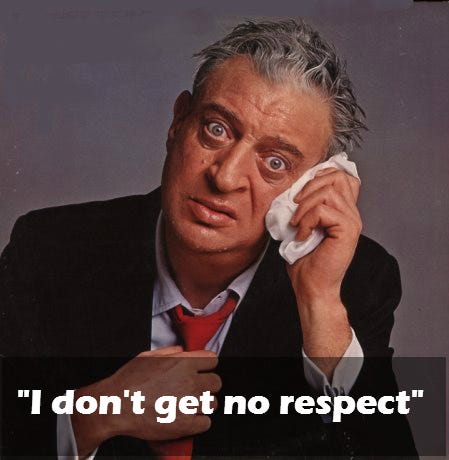
Image Description: A grey-haired Rodney Dangerfield wearing a suit pulls down his tie with one hand and holds a white handkerchief to the side of his stress-out face with the words written: “I don’t get no respect”.
The comfort I find in Lucy’s newsletter is that of sharing these same frustrating experiences and knowing that I am not alone — that I am, in fact, in excellent company.
Thanks for reading Rolling With It! I love hearing from readers, so comments are warmly welcomed. If you enjoy this newsletter, please “like” it to let people know it is worth checking out. Thanks so much for your support!
Thanks for sharing Lucy Webster's Substack and book. Also--"Often, I try to tell myself otherwise and convince myself that I am misreading the signals. But after this newsletter, I am trusting my gut instincts forevermore about when and where I feel the stomach-churning sensations of dehumanization." To trusting our gut! :).
Lucy's book and Substack are two of my favorites. Even though I can't always relate directly to her experiences, the way she describes how they make her feel or affect her profoundly resonates with me. Love hearing your thoughts on her recent article and how it resonated with you too.