

News Comment: Historical Ruptures of Disabled Decorum
Or: Sometimes Activist Actions Speak Louder Than Polite Words

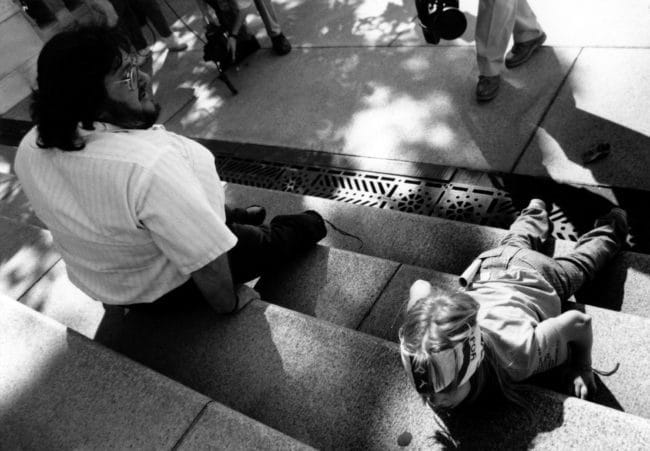
Source: Tom Olin/The Ability Center
Image Description: Jennifer Keelan crawls up the steps of the U.S. Capitol on March 12, 1990.
The mere existence of disabled people has sometimes been considered by society to break the rules of decorum — much less, their demands for accessibility, equality, and inclusion. We don’t have to look back very far in the historical records for efforts to erase disabled people from public view, deny their humanity, and restrict their rights. And, dare I observe: this trend is happening again to even a stronger degree through recent federal government actions.
The Ugly Laws
Many people are unaware that the “Ugly Laws” in various jurisdictions across the U.S. sought to ban visibly disabled people (often poor and homeless) from spending time in public. The purpose is explained briefly:
“So-called “ugly laws” were mostly municipal statutes in the United States that outlawed the appearance in public of people who were, in the words of one of these laws, ‘diseased, maimed, mutilated, or in any way deformed, so as to be an unsightly or disgusting object.’”
Under the guise of improving public life, these laws were passed so that “unsightly” people could be arrested and detained. Later, disability advocates fought hard to eradicate many of these laws, but some still linger. (Read for more detail about the history and impact of “Ugly Laws”.)
Disability advocates argue (strongly, in my opinion) that actions of the current government are attempting to bring back these laws and relegate disabled people and others considered undesirable to the margins through arrest and institutionalization. It’s worth questioning whether marginalizing and arresting disabled people is actually breaking decorum more than the natural existence of disabled humans.
504 Protests and Federal Building Occupation
By 1977 disabled advocates had waited four long years for regulations that would implement the Rehabilitation Act (or Rehab Act) to make federal buildings and services accessible to people with disabilities. They had spent those years politely writing letters, lobbying, and asking lawmakers nicely for the regulations that would activate the law. After issuing a deadline for the government to take action, disabled advocates began nationwide protests and even took over some federal buildings in various cities. None lasted as long as the group in San Francisco, which occupied a federal building for nearly one month.
A special Congressional hearing was convened where advocates spoke about the need for the regulations to ensure disabled people were granted equal access to federal services and programs. The New York Times quoted Judy Heumann in a story commemorating an anniversary of the protests and their aftermath:
“‘We will no longer allow the government to oppress disabled individuals,’ Ms. Heumann said that spring at a special hearing with members of Congress after a government official suggested creating “separate but equal” programs. ‘We want the law enforced. We will accept no more discussion of segregation.’”
To be sure, occupying a government building is a significant breach of decorum. But I would argue this level of peaceful, yet forceful, protest became necessary when their government refused to hear their concerns, do the work of approving regulations for a law that had been enacted, and failed in their duties to respect and protect their disabled citizens. Much of the Americans with Disabilities Act was rooted in the Rehab Act (and its 504 regulations), outlining that in addition to government places, programs, and services, those that are publicly available by businesses should also be made equally accessible to people with disabilities.
Unfortunately, a group of states is currently suing the federal government to remove the Rehab Act 504 regulations by calling them unconstitutional. This would render toothless requirements for accessibility and equity for disabled people under federal government programs and services — but it has a wider reach due to how many health care and other services are funded by the federal government. Read this explanation from DREDF:
“Section 504 is an important law that protects people with disabilities. Section 504 covers all parts of society that get money from the United States government.
Section 504 says you can’t discriminate against disabled people if you get money from the United States government. Section 504 says you cannot treat people badly or exclude them because of their disabilities. It says you must include people with disabilities in programs and provide reasonable accommodations. It says you must provide services to people with disabilities in integrated settings. This means providing services in the community instead of only in institutions like hospitals and nursing homes.
Section 504 has rules that explain what disability discrimination is. The rules say that places like schools, hospitals, and doctors’ offices have to include people with disabilities. The rules say what these places have to do to include people with disabilities. The rules say that state and local healthcare, mental health, and disability agencies have to think about people with disabilities and make sure they can get services in the community and not just in institutions.”
In sum, if these states are successful in removing the Rehab Act’s 504 regulations, much of the U.S. progress on accessibility and inclusion of disabled people (from educating disabled children to providing people with disabilities accessible health care) will dissolve and erode. It would be a huge reversal in human rights. Learn more and take action (especially if your state is a party to the lawsuit), if you believe equality for disabled people belongs in our laws and should not be erased.
Unfortunately, another attack from the federal government was launched on the long-established right of disabled people to live in the community when the U.S. Department of Justice issued guidance on June 18 (just days before the anniversary of the groundbreaking Olmstead Supreme Court decision affirming this right). The guidance falsely declared there is no existing laws (which there are several: Rehab Act and the Americans with Disabilities Act) nor legal court finding (again, there is: the Supreme Court’s Olmstead decision from 1999) ensuring the right of disabled people to live in the community. NPR provides an informative overview of this malicious guidance, how it violates 30+ years of legal precedence, and the harms that will likely follow.
Who needs help to eviscerate disability rights when our own federal government is doing the dirty work? A great deal of damage will be done while the federal government refuses to enforce Olmstead related complaints following this guidance.
Denver Bus Protests
In 1978, disabled activists flipped decorum on its head. When the local public bus provider refused to make transit buses accessible for wheelchair users, activists surrounded buses stopped on their route in downtown Denver and blocked them for 24 hours. Check out the photo of disabled people sleeping on the street.
From one vantage point, it was shocking and indecorous that disabled people blocked the buses that were refusing to accommodate them. No one expected this level of protest and local police had no way of arresting them because their vehicles were all inaccessible as well!
But the previous (more polite and decorous) requests to make bus service accessible had been ignored and disabled people were sick of paying taxes to support a public transportation system that wouldn’t provide them equal (or any) service. Ultimately, Denver and the local transit provider committed to purchasing accessible buses, which has led to the widespread accessibility of bus transportation that we experience today. These protests led the way for organizing and success on many other disability rights issues.
ADA Capitol Crawl
In early 1990 after months of waiting for the Americans with Disabilities Act (can you sense a theme?), disabled advocates took to the streets and to the steps of the Capitol. Sometimes making a point involves making some potent pictures, especially those that are likely to make the news.
As the ultimate symbolism of inaccessibility and the lack of equality afforded to people with disabilities in the U.S., advocates dropped their mobility aids and scooted out of their wheelchairs to crawl up the steps of the Capitol building where their legislators hemmed and hawed about passing this signature legislation. See this article about what happened and the powerful photos that were captured:
“On March 12, 1990, ADAPT led a procession of more than 500 marchers, including other disability activists and lobbyists, from the White House to the west side of the U.S. Capitol. There, in the kind of guerrilla civic action for which the organization had become known, scores of marchers dropped to the ground and began the long journey up the hard marble stairs leading to the “People’s House.” They climbed backwards or on their hands and knees, step-by-painstaking-step. “As I’m seeing the people around me,” recalled Anita Cameron, one of the ADAPT activists who made her way up that day, “I’m like, ‘whoa, we are doing it. We are really doing it. We’re, like, crawling into history.’””
The images of disabled people crawling were shocking, so much so that the law was quickly passed and signed in less than six months on July 26, 1990. Disabled people had by now learned that breaking decorum was frequently necessary to be heard and for their rights to be considered by a society often unwilling to listen to more polite requests for change.
Final Thoughts on Decorum
This brief historical look back reminds me that disabled people are often considered indecorous just for existing, and often have to speak louder than words in order to be heard by a society reluctant to include them. For all the advocacy that is conducted through polite letters, meetings, and hearings — sometimes it is the obstructive, persistent, or shocking actions and visuals that finally convey the necessary message: we will be heard and included.
Thanks for reading Rolling With It! I love hearing from readers, so comments are warmly welcomed. If you enjoy this newsletter, please “like” it to let people know it is worth checking out. Thanks so much for your support!
Thank you for reminding us how hard the community fought for their human rights, and how quickly and deceitfully they can be dismantled by those who refuse to understand.
This was a really interesting read, and the imagery is powerful, thank you Kelly.